The Industrial Backbone of Omaha Runs Through L Street
The L Street Corridor in Omaha, Nebraska, is not just another commercial strip.
It is one of the city’s most active industrial arteries — connecting manufacturing facilities, food processing plants, fleet service centers, and distribution warehouses directly to Interstate 80 and regional freight routes.
This corridor has powered Omaha’s working economy for decades.
And in recent years, it has continued to evolve — with infrastructure upgrades, industrial expansion, and commercial redevelopment reinforcing its long-term importance.
In high-demand industrial zones like this, commercial roofing is not cosmetic.
It is operational infrastructure.
From the Stockyards to Modern Industrial Scale
The industrial identity of L Street dates back to the historic Omaha Union Stockyards at 30th and L Street. Established in the late 19th century, the Stockyards once ranked among the largest livestock markets in the world and anchored South Omaha’s economy for generations.
While the Stockyards closed in 1999, the industrial character of the corridor never disappeared.
Today, companies such as Greater Omaha Packing Co. continue operating and expanding near L Street, alongside manufacturing, logistics, mechanical service, and distribution companies that rely on large-scale industrial facilities.
And those facilities depend on roofing systems that can withstand:
- Large flat spans
- Heavy rooftop mechanical systems
- Freight vibration
- Extreme Midwest temperature swings
- Snow load and severe storm exposure
In this environment, roofing failure is not an inconvenience.
It’s an operational risk.
Over 520,000 Square Feet of Commercial Roofing Completed in Recent Years
520,000+ Square Feet Installed Within Blocks of L Street
In recent years, Armour Roof Co. has completed more than 520,000 square feet of commercial roofing projects within just a few blocks north and south of Omaha’s L Street Corridor.
That equates to:
- Nearly 12 acres of flat roofing surface
- Multiple large-scale industrial facilities
- Active operational buildings protected and maintained
This concentration of completed projects within a defined industrial radius reflects repeated trust from facility managers operating in one of Omaha’s most infrastructure-dependent zones.
Trusted by Industrial Operators Along the Corridor
Armour Roof Co.’s recent projects in the L Street area include work for:
- Commonwealth Electric Company of the Midwest
- Nebraska Machine Products
- Johnstone Supply
- Skylark Meats
- Becker Trenching
- Bauer Built Tire & Service
- Kosiski Auto Parts
- D&J Beverage
- Midwest Sound & Lighting
- Hatcher Mobile Services
- Axcion Foodservice
- Nebraska Warehouse Co.
These companies represent diverse industrial categories:
- Electrical and mechanical services
- Precision manufacturing
- Food processing
- Fleet and transportation services
- Distribution and warehousing
- Industrial supply
Each facility presents unique roofing challenges, including:
- Large flat roof spans
- Rooftop HVAC and mechanical systems
- Active freight loading environments
- Strict uptime requirements
Completing over half a million square feet of roofing in this environment requires operational coordination, safety compliance, and long-term performance planning.
Infrastructure Investment Signals Continued Growth
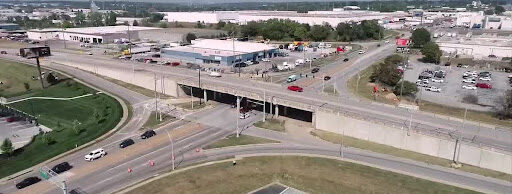
The ongoing reconstruction of the 72nd and L Street intersection — converting the former bridge into an at-grade signalized intersection — reflects the city’s long-term investment in this corridor.
Increased traffic capacity and improved freight mobility signal continued commercial demand.
For property owners and industrial tenants, that means:
- Increased utilization
- Higher operational loads
- Greater long-term asset protection needs
Commercial roofing in this corridor must match that scale.
Commercial Roofing Built for Industrial Continuity
The L Street Corridor has evolved from livestock pens to logistics hubs — but its core identity remains industrial.
Facilities here are built for production, movement, and durability.
In recent years, Armour Roof Co.’s 520,000+ square feet of completed commercial roofing projects within this concentrated zone demonstrate:
- Proven performance in active industrial settings
- Experience with large-scale flat roofing systems
- Trust from facility managers across multiple sectors
- Long-term commitment to Omaha’s industrial backbone
In an area defined by infrastructure and operational intensity, roofing is not decorative.
It is structural protection for the businesses that keep Omaha moving.
FAQ